

Backpacker trek
Santa Cruz Trek 4 days
Explore Peru’s Cordillera Blanca on the 4-day Santa Cruz Trek from Huaraz. Hike through Huascarán National Park, cross Punta Unión Pass at 4,750 metres, and spend three nights camping among glacial lakes and snow-covered peaks. A rewarding adventure for active, well-acclimatized hikers.
What trekkers say
Read all reviewsNext departures
See all dates- Reach the Punta Union Pass, visit Arhuaycocha lake, and see the Paramount Pictures mountain
- 4-season tent, down sleeping bag, sleeping pad and foam mattress included
- Hike with only your daypack, all equipment and luggage carried for you
- Licensed, English speaking guides with first-aid training
Confirmed means the departure is set to run. When a departure is still forming, we show exactly how many more trekkers are needed.
October 2026
November 2026
December 2026
How forming departures, deposits and refunds work
A green confirmed label means this departure is set to run and you can book your place. We will not cancel it because too few people join. Only exceptional safety, legal or other events beyond our reasonable control could require a change or cancellation. If we cancel before the trek starts, you can choose another available date or receive a full refund of what you paid for the trek.
We confirm or cancel a forming departure no later than 3 days before its scheduled start. If we cannot run it and you do not want another available date, we refund 100% of what you paid for that trek booking. If you cancel before our decision, our normal traveler cancellation terms apply.
Booking for two or more? Ask us about opening a new date. We can promote it to other trekkers. We may also offer a semi-private option at a price agreed with you in advance. A requested date is confirmed only when we confirm it in writing.
For bookings made more than 15 days ahead, the deposit is 50% and the balance is due 15 days before departure. Bookings accepted within 15 days require full payment when booked.
Included
Guiding & staff
- Briefing at our Andes Treks office in Huaraz the evening before the trek
- English-speaking, licensed guide
- Mountain cook
- Donkey driver(s) and donkeys
Equipment
- 4-season Doite tent (per 2 persons)
- −11°C down sleeping bag (limit)
- Comfortable R-value 4.6 sleeping pad
- Foam mattress (R-value 1.8+) underneath the sleeping pad
- Sea to Summit mummy liner for extra hygiene
- Dining tent, tables, stools and other camping equipment
- Cleanwaste portable toilet and Cleanwaste portable seat
- Personal duffle bag (up to 3 kg)
Food & water
- All meals prepared with fresh, local ingredients
- Breakfast, lunch and dinner
- Daily snack provided
- Safe, boiled drinking water throughout the trek for refill (from day 2)
Logistics
- Pick up at your stay in Huaraz (city center)
- Transport Huaraz – start point
- Transport end point – Huaraz
- Drop off at our office in Huaraz
- Luggage storage in Huaraz at our office
Safety
- Radio communication
- First aid kit & evacuation protocol
- Emergency oxygen
Excluded
- National Park of Huascaran entrance fee (approximately 60 Peruvian soles)
- Trekking poles (highly recommended, available for rent)
- Personal travel insurance (highly recommended)
- Breakfast day 1, lunch and dinner day 4
- Hotel nights in Huaraz before and after the trek
- Personal trekking clothing and footwear
- Additional snacks and personal drinks
- Alcoholic beverages
- Emergency horse
- Tips for guides, cook, and support staff
- Personal medical expenses
- Any costs caused by early departure from the trek
- International and domestic flights
- Extra services not listed under “Included”
These optional extras are not included in the trek price. You choose them inside the WeTravel booking process: after you click Book now, the booking form lists every extra below with its price, and you add the ones you want before you pay.
| Extra | Price (USD) |
|---|---|
|
Entrance to National Parc of Huascaran
Or pay 60 soles at the briefing... This add-on covers the required entrance for the Cordillera Blanca throughout your selected trek. The exact fees depend on your chosen itinerary, the number of trekking days and the communities visited. By adding this option, Andes Treks will arrange and manage the applicable entrance payments for your complete itinerary. Recommended for a smooth and worry-free trekking experience. Subject to availability and possible changes in local community fees or access conditions. |
$25.00 |
|
Premium sleeping bag -18 degrees celsius
Rent a premium cold-weather sleeping bag for the full duration of your Huayhuash trek... Nights in the Huayhuash mountains can be extremely cold, particularly at high-altitude campsites. This premium sleeping bag is designed for cold mountain conditions and has a temperature rating of approximately -18°C limit. It provides significantly more warmth and insulation than a standard trekking sleeping bag, helping you rest and recover properly between demanding trekking days. The sleeping bag is lightweight for its warmth level and suitable for multi-day camping in the high Andes. Your sleeping bag will be prepared before departure and available for every camping night included in your trek. Please note that temperature ratings are general manufacturer guidelines. Individual comfort can vary depending on weather conditions, altitude, clothing, sleeping mat and personal sensitivity to cold. One of the most valuable comfort upgrades for a warm and restful night in the mountains. Subject to availability. The exact brand and model may vary. |
$32.00 |
|
Professional trekking poles
Rent a pair of professional trekking poles for the full duration of your Huayhuash trek... The Huayhuash Circuit includes steep ascents, long descents, rocky trails, loose gravel and uneven mountain terrain. Trekking poles provide additional balance and stability while helping to reduce pressure on your knees, ankles and leg muscles. They are especially useful during long downhill sections, high mountain passes and wet or slippery conditions. The poles are adjustable, lightweight and suitable for multi-day trekking at high altitude. We provide professional trekking poles from trusted brands such as Leki or Black Diamond. The exact brand and model provided may vary. Your trekking poles will be provided before departure and can be used throughout your complete trek. Highly recommended for greater comfort, stability and confidence on the trail. Subject to availability. |
$25.00 |
|
Daypack 32L
Rent a comfortable 32-litre daypack for the full duration of your trek... A 32L daypack offers enough space for the essential items you need during each trekking day, including water, snacks, rain protection, warm layers, sun protection, personal medication, a camera and other small belongings. The practical size makes it spacious enough for mountain conditions without being unnecessarily large or heavy. It is ideal for carrying your daily essentials while the main luggage allowance is transported separately according to the conditions of your selected trek. The daypack will be provided before departure and remains available for your complete Huayhuash itinerary. A convenient choice for travelers who do not want to bring or purchase their own trekking backpack. Subject to availability. The exact brand, model and design may vary. |
$16.00 |
|
Private tent
Enjoy additional privacy and personal space with your own tent throughout the trek... Standard accommodation is normally based on two travelers sharing one tent. By selecting the private tent add-on, you will have a tent reserved exclusively for your individual use for every camping night included in your itinerary. A private tent gives you more room to organize your belongings, change clothes and relax comfortably after each trekking day. It is especially recommended for solo travelers, light sleepers or anyone who values greater privacy during a multi-day mountain adventure. Your private tent will be transported, installed and packed away by the trekking team at each campsite. Upgrade your trek with more privacy, space and comfort at camp. Subject to availability. The exact tent brand, model and size may vary. |
$36.00 |
Camping equipment provided for Santa Cruz Trek 4 days.
Every item shown below is included in your trek price.
Doite Pro Aconcagua 4-season tent
A strong 4-season expedition tent built for demanding mountain conditions. Designed to provide reliable protection against heavy rain, strong winds, and low temperatures, with comfortable space for up to three people, but shared per 2 persons.
IncludedMarmot down sleeping bag – limit -11°C
A warm and lightweight sleeping bag filled with 650-fill-power duck down, ideal for cold nights in the Andes. ISO tested: Comfort -5°C / Limit -11°C.
IncludedR4.6 Inflatable sleeping pad
A lightweight insulated sleeping pad designed for extra warmth and comfort during cold mountain nights. It is placed on top of the foam sleeping pad for better insulation and a more comfortable sleep.
IncludedR1.8+ Foam sleeping pad
A durable closed-cell foam sleeping pad that provides reliable insulation from the cold ground and cannot be punctured. It is placed underneath the inflatable pad for extra warmth, protection, and comfort.
Included- Huaraz – Vaqueria – Paria
- Paria – Punta Union Pass – Taullipampa
- Taullipampa – Arhuaycocha Lake – Llamacoral
- Llamacoral – Cashapampa – Huaraz
Daily elevation profile for Santa Cruz Trek 4 days.
- 437 m | 1434 ft
- 951 m | 3120 ft
- 361 m | 1184 ft
- 24 m | 79 ft
Our Santa Cruz Trek: 4 days in Peru’s Cordillera Blanca. Walk beneath snow-covered mountains, follow clear rivers through open valleys, and spend three nights camping in the Peruvian Andes. The 4-day Santa Cruz Trek from Huaraz brings together the landscapes that make the Cordillera Blanca such a special place to hike: steep mountain walls, glacial lakes, quiet trails, and the crossing of Punta Unión Pass at approximately 4,750 metres.
This classic trek takes you through Huascarán National Park in northern Peru. It is a rewarding choice if you want several days in the mountains without committing to a long expedition. There is time to settle into camp, enjoy the changing light on the peaks, and experience the simple rhythm of walking, eating, and resting outdoors.
At Andes Treks, we want you to arrive knowing what the journey involves. Santa Cruz is a proper mountain trek. Good preparation, enough time to acclimatize, and realistic expectations will help you enjoy it much more.
Important Santa Cruz Trek information
- Location: Cordillera Blanca, Huascarán National Park, Áncash, Peru.
- Usual travel base: Huaraz, at approximately 3,050 metres.
- Classic duration: 4 days and 3 camping nights.
- Route: a crossing between Vaquería and Cashapampa. The trek can be walked in either direction.
- Highest trekking point: Punta Unión Pass, approximately 4,750 metres / 15,584 feet.
- Distance: approximately 45–50 kilometres for the classic crossing. Longer versions with side walks can reach roughly 50–60 kilometres.
- Difficulty: moderate to challenging, mainly because of the altitude, sustained walking, and uneven ground.
- Best general weather window: May to September, with April and October offering more changeable conditions.
- Preparation: allow at least 3 days in the Huaraz region before departure, and more time if needed.
Distances and walking times depend on the exact trail, campsites, optional visits, and group pace. Use your confirmed itinerary when planning your trip. The trek takes place inside a protected area, so check the current park entrance arrangements and whether the fee is included in your booking.
Santa Cruz Trek briefing and luggage storage in Huaraz
The pre-trek briefing is an important part of your preparation and is mandatory under the Andes Treks booking terms. Keep the evening before departure free and follow the meeting details sent by our team. Arrive with your questions, your planned clothing, and a clear idea of anything you still need to arrange.
The briefing is the time to review the route, expected weather, daily walking plan, pickup arrangements, meals, water supply, and camping routine. Tell the team about relevant health conditions, medication, food allergies, and dietary needs before the trek, rather than waiting until you reach the first campsite.
Pack separately for the trail and for storage
Leave items you will not need on the mountain in Huaraz. Arrange luggage storage with our team or your accommodation before departure, and confirm the location and collection time. Keep your bags closed and labelled. Carry your identification, essential medication, money, and valuables in your daypack.
If your package includes a duffel bag and animal transport, follow the allowance stated in your booking. Ask whether sleeping equipment counts towards that limit. Your duffel may travel separately from you during the day, so pack your waterproofs, warm layer, water, snacks, and personal essentials where you can reach them.
What to expect on the Santa Cruz Trek
Several active days in a high mountain environment
Expect early starts, uphill sections, long descents, and a slower walking pace than you may be used to at home. Some stretches are comfortable valley paths; others are rocky, dusty, muddy, or uneven. The pass day is usually the main physical challenge. An optional lake visit can also create a long walking day.
Walk at a steady pace and tell your guide early if you are struggling. There is no benefit in rushing to keep up while hiding a headache, nausea, or unusual exhaustion. A good group experience depends on honest communication and respect for different walking speeds.
Simple camping and limited facilities
Expect tent accommodation and basic mountain facilities. Do not plan around hot showers, heated rooms, reliable electricity, or mobile coverage. Ask about the toilet arrangements for your departure. Bring a headlamp, personal hygiene items, and enough battery power for the trek.
Keep your sleeping clothes dry, organize your bag before dark, and have a warm layer ready when you stop walking. These small habits make evenings at camp much more comfortable. Shared campsites may also have other trekking groups, so quiet hours and consideration for your neighbours matter.
Food, drinking water, and route changes
Check which meals are included on the first and last days and when treated drinking water becomes available. Start the trek with the amount of water advised by the team. Never assume clear river or lake water is safe to drink untreated. Carry a few familiar snacks that you enjoy eating during exercise.
Weather, trail conditions, access problems, and the health of the group can affect the plan. Your guide may change the schedule, skip a side walk, or turn back. Mountain views and visits to every named viewpoint cannot be guaranteed.
Respect the national park and local communities
Keep rubbish in your bag, including tissues and food wrappers. Use the toilet system explained by your guide, keep soap out of streams and lakes, and avoid disturbing wildlife. Give pack animals space on narrow paths, respect farm gates, and ask before photographing local people.
Santa Cruz Trek equipment and packing guide
Pack for bright sunshine, cold evenings, wind, and rain on the same trip. Choose clothing you can add or remove easily. Test your footwear and daypack before travelling, and avoid making the trek the first outing for important equipment.
Camping equipment to check before departure
Review the equipment list for your selected package. Confirm the tent-sharing arrangement, sleeping bag, sleeping mat, dining setup, and any personal luggage transport. If you want a private tent or need rental equipment, request it in advance and check availability.
For sleeping bags, ask for the comfort rating, not only the limit or extreme rating. These ratings mean different things. Choose a sleeping system suitable for the expected camp temperatures and tell the team if you usually feel cold at night. Ground insulation matters as much as the bag itself; a thin mat can leave you cold even inside a warm sleeping bag.
Clothing and footwear
- Comfortable hiking footwear with a reliable grip, already worn on longer walks.
- Quick-drying hiking shirts and trousers.
- Thermal base layers and a fleece or similar warm mid-layer.
- An insulated jacket for rest stops and camp.
- A waterproof jacket and rain trousers.
- A warm hat, gloves, sun hat, and neck covering.
- Hiking socks, spare underwear, and dry socks for sleeping.
- Light camp footwear if space and your luggage allowance permit.
Daypack and personal essentials
- A comfortable daypack, usually around 25–35 litres, with waterproof protection.
- Reusable water bottles or a hydration system with enough capacity for the day.
- Sun protection: sunglasses, sunscreen, and lip balm with SPF.
- A headlamp and spare batteries or a charged backup.
- Personal medication, blister care, and a small personal first-aid kit.
- Trekking poles if you use them, especially for long descents.
- Toiletries, hand sanitizer, toilet paper, and bags for carrying out waste.
- Insect repellent for lower valleys, plus a power bank and charging cable.
- Waterproof inner bags for electronics, sleeping clothes, and important documents.
A rain cover alone may not keep everything dry during sustained rain. Protect important items inside the bag as well. Keep the load manageable: bring what you need for four mountain days, and leave spare city clothing in Huaraz.
Acclimatization before the Santa Cruz Trek
Andes Treks recommends a minimum of 3 days in the Huaraz region before Santa Cruz. Treat this as a starting point for planning, not a guarantee that you will be ready. Some people need longer, especially after arriving from sea level or after previous problems at altitude.
Take the first days gently. Rest after your journey, eat regularly, and begin with easy activity. Once you feel well, discuss a gradual preparation walk with the team. Do not make a demanding high-altitude day hike your first activity after arriving.
Being fit does not prevent altitude illness. Your body needs time to adjust, and sleeping higher can bring new symptoms even if you felt comfortable in Huaraz. If you have a headache, nausea, or unusual fatigue before departure, tell the team and reassess the plan.
Allow room in your travel schedule for extra rest. Reaching Huaraz just in time for the briefing is not a suitable preparation plan for a trek that crosses 4,750 metres.
Santa Cruz Trek health, altitude sickness, and medication
Speak with a qualified clinician before travelling if you have a medical condition, are pregnant, have had serious altitude illness, or are unsure whether this trek is suitable. Describe the actual trip: several days of walking, camping at altitude, and limited access to medical care.
Recognize symptoms and act early
Altitude illness can cause headache, nausea, dizziness, loss of appetite, and unusual tiredness. Tell your guide immediately. Do not continue higher while you have altitude illness symptoms. Symptoms that worsen despite rest at the same altitude require descent and medical assessment.
Confusion, difficulty walking straight, or breathlessness at rest are emergency warning signs. They need urgent action, including descent and medical help. Do not wait until morning or try to finish the route first.
Bring your own medication and prepare for remote travel
Carry enough regular medication for the whole trip, with extra supplies in case of delays. Keep essential doses in your daypack, protected from moisture. Tell the team about allergies and any medicine that may affect your care in an emergency.
Ask your clinician whether altitude medication, such as acetazolamide, is appropriate for you. Do not borrow someone else’s prescription or use medication as a reason to ignore symptoms. Avoid alcohol during early acclimatization and do not take sedating sleep medicines without medical advice.
Choose travel insurance that explicitly covers your planned trekking altitude, medical treatment, and evacuation. Check the wording with your insurer. Carry the policy number and emergency contact details, and understand that access to help can take time in remote terrain.
How long is the Santa Cruz Trek?
The classic Santa Cruz Trek takes 4 days and 3 nights. The first and last days usually combine walking with road transport between Huaraz and the trailheads. Four days describes the trekking programme; it does not include your journey to Huaraz or the preparation time before departure.
For a practical travel plan, allow at least three preparation days in the Huaraz region, four trekking days, and some flexibility afterwards. Avoid a tight connection on the final evening. Road conditions and the group’s progress can affect your return time.
A typical 4-day Santa Cruz route
The following outline shows the common Vaquería-to-Cashapampa direction. The exact camps, direction, and side walks depend on your confirmed departure.
- Day 1: Huaraz to Vaquería and the Huaripampa Valley. Travel to the trailhead and begin walking through the valley towards a camp in the Paria area.
- Day 2: Punta Unión Pass and Taullipampa. Climb to the main pass, then descend into the Santa Cruz Valley for the next camping night.
- Day 3: Santa Cruz Valley and an optional Arhuaycocha visit. Continue through the valley towards Llamacorral. A side walk towards Arhuaycocha Lake adds distance and depends on the itinerary, conditions, and available time.
- Day 4: Cashapampa and return to Huaraz. Descend towards the trailhead and travel back to town.
Some operators offer a three-day version. This compresses the schedule and may leave out side walks. A shorter itinerary does not remove the altitude challenge and is not automatically a better option for someone with limited experience.
Why choose the 4-Day Santa Cruz Trek?
Four days gives the journey a useful balance. You experience a full mountain crossing and several nights outdoors, while keeping the trek short enough to combine with other places in Peru.
- Time to enjoy the route: the journey has room for breaks and camp life, rather than focusing only on reaching the next stop.
- A rewarding mountain goal: crossing Punta Unión gives the trek a clear highlight and a sense of achievement.
- Variety within one trip: village paths, open valleys, lakes, and high mountain scenery change as you walk.
- A manageable introduction to multi-day trekking: prepared hikers can experience camping at altitude without committing to a much longer circuit.
- Space for an extra viewpoint: where the programme and conditions allow, a side walk can add another perspective on the surrounding peaks.
Choose four days because you want time on the trail. You still need to prepare for long walking days and arrive acclimatized.
Santa Cruz Trek elevation, distance, and difficulty
How high does the Santa Cruz Trek go?
The highest point on the classic walking route is Punta Unión Pass at approximately 4,750 metres. Common camps include Paria at around 3,870 metres, Taullipampa at around 4,250 metres, and Llamacorral at around 3,750–3,760 metres. Actual tent locations vary.
The altitude you sleep at matters as well as the highest point you cross. You will spend several nights well above sea level, so good preparation remains important even on a day that mostly goes downhill. A road transfer via Portachuelo de Llanganuco can also briefly reach about 4,767 metres; this is separate from the trek’s highest walking point.
How far will you walk?
PROMPERÚ describes the classic Llanganuco–Santa Cruz route as approximately 47 kilometres. Different trailhead locations, camps, and detours explain why published totals vary. A programme that includes Arhuaycocha can be considerably longer than a direct crossing. Compare the full itinerary rather than assuming every four-day Santa Cruz trek covers the same distance.
Is Santa Cruz suitable for beginners?
It can suit someone new to multi-day trekking who already enjoys long hikes, has prepared well, and is comfortable camping. It is a poor choice as a first attempt at regular exercise. In normal conditions, the classic route does not require technical climbing, but altitude and weather can make an ordinary trail feel demanding.
Prepare with longer walks on hills and uneven ground. Practise descending as well as climbing, and walk with the daypack you plan to carry. Ideally, you should feel comfortable completing several hours of walking and doing another active day afterwards. This builds endurance; it does not replace acclimatization.
Santa Cruz Trek weather and best time to go
May to September is generally the best period for the Santa Cruz Trek. These months usually offer a better chance of dry walking conditions and clear mountain views. June, July, and August are popular choices for a trip focused on the high peaks.
Huascarán National Park lists May to October as its recommended visiting period, while also identifying October to April as the rainy season. The overlap reflects a transition: the seasons do not change on a fixed date, and October can be much less settled than the middle of the dry season.
Cold nights, strong sunshine, and sudden changes
Prepare for nights below freezing at high camps. A sunny valley can feel warm while an exposed pass feels cold in the wind. Rain, hail, and snow are possible even during the drier months. Keep waterproofs and warm clothing accessible every day.
A forecast for Huaraz does not describe conditions at Taullipampa or Punta Unión. Elevation, cloud, wind, and exposure all affect how cold you feel. Ask about the expected conditions close to departure rather than packing around one average temperature.
Santa Cruz Trek weather by month
This month-by-month guide is a planning interpretation of the region’s usual seasons, not a forecast or a set of measured campsite averages. Conditions vary between years. Departure availability and route suitability must be checked separately.
January: rainy-season trekking conditions
January falls in the wet season. Prepare for rain, damp ground, and cloud that may hide the peaks. If this is your only travel window, keep your schedule flexible and check local trail and road conditions before committing to the trek.
February: plan for wet trails and limited visibility
February remains a rainy-season month. Wet equipment and slippery ground can make camping and walking more demanding. Choose this period only with realistic expectations about views and with a confirmed assessment that the proposed departure can operate.
March: rain remains part of the plan
March is still within the wetter part of the year. A few clear mornings do not mean the dry season has begun. Waterproof packing and flexibility remain important, and a plan based on uninterrupted mountain views may be disappointing.
April: a transition towards the trekking season
April can offer improving conditions as the main dry season approaches, although showers remain possible. Expect a mix of weather rather than a dependable dry spell. Check recent reports, particularly if your visit falls early in the month.
May: a strong choice for a Santa Cruz Trek
May usually brings a more favourable balance for trekking. It is a useful month to consider if you want to travel near the start of the dry season. Keep rain protection in your pack, as the change from wetter weather can be gradual.
June: dry-season walking and cold camps
June is within the main trekking window. Plan around cold evenings and carry the layers you need once the sun leaves camp. Good visibility can reward an early start, but warm sunshine during a break is not a reason to leave your jacket behind.
July: popular trekking dates in the dry season
July is a popular choice for Santa Cruz. Arrange your preferred departure and any rental equipment ahead of time. Pack carefully for freezing nights, and expect to share some campsites with other groups rather than having the valley to yourself.
August: good seasonal prospects for mountain views
August remains within the drier trekking season and is another popular travel month. Prepare for cold camps and wind on exposed ground. Give yourself enough preparation days in Huaraz even when a short weather forecast looks excellent.
September: late dry-season trekking
September is often a good option for a late-season trip. Weather can become more changeable as the month progresses, so keep the same complete packing list you would use earlier in the year. Check availability rather than assuming every date has a group.
October: more variable weather
October sits around the return of wetter conditions. Good trekking days are possible, but a flexible attitude becomes more valuable. If your dates are fixed, discuss current conditions with the team and leave room for changes to the route or schedule.
November: wet-season preparation matters
November is within the rainy season. Do not judge the whole route by a dry afternoon in Huaraz. Confirm whether a suitable departure is available, and be prepared for a different experience from the clear-sky photographs usually used to promote the trek.
December: check conditions before booking
December brings wet-season uncertainty to a multi-day camping trip. Holiday dates do not guarantee suitable mountain conditions or regular departures. If panoramic views are your main reason for visiting, consider whether you can travel during the drier months instead.
Who is the Santa Cruz Trek best for?
Santa Cruz is a good match for active travellers who enjoy nature, are willing to prepare, and want a few days away from normal comforts. You do not need to be a mountaineer, but you do need patience with mountain conditions and enough fitness for consecutive walking days.
- Regular hikers: a rewarding next step if you are ready to add camping and altitude to your experience.
- Couples and friends: a shared outdoor challenge with time together on the trail and at camp.
- Solo travellers: a group departure can provide company and an organized way to experience the route.
- Landscape photographers: varied scenery and changing light, with the understanding that weather and the group schedule come first.
- Travellers with a shorter mountain itinerary: four trekking days leave room for other destinations, provided you also allow time to acclimatize.
If you need daily hot showers, dependable internet, or easy access to medical facilities, this camping route may not meet your needs. Families should discuss children’s hiking experience and the suitability of the itinerary with the team before booking. Age alone does not establish readiness.
Santa Cruz Trek vs Huayhuash Trek: which should you choose?
Both treks offer impressive mountain scenery from a Huaraz travel base. Santa Cruz is the shorter choice, with one main pass and three camping nights. Longer Huayhuash circuits involve repeated high passes and more consecutive days of effort, so they ask more of your endurance and recovery.
Choose Santa Cruz if you want a complete mountain crossing within a shorter visit. Consider Huayhuash if a longer trekking journey is the main purpose of your trip and you are prepared for its physical demands. Short Huayhuash itineraries also exist, so compare the specific route rather than the destination name alone.
Explore our 8-day Huayhuash Trek if you are considering a longer adventure. Completing Santa Cruz can help you learn how you respond to camping and altitude, but it does not automatically make you ready for every Huayhuash route.
Santa Cruz Trek vs Salkantay Trek: Huaraz or Machu Picchu?
The main difference is the journey you want. Santa Cruz explores the Cordillera Blanca from Huaraz. Salkantay usually starts from the Cusco region and is commonly sold as a four- or five-day journey that includes a visit to Machu Picchu.
Classic Salkantay itineraries cross a pass at about 4,630 metres before descending towards warmer valleys and cloud forest. Accommodation can range from camping to fixed lodges, depending on the package. Santa Cruz centres on high mountain valleys and tent camping.
Choose Santa Cruz for a compact alpine trekking experience in northern Peru. Choose Salkantay if combining a mountain walk with Machu Picchu is your priority. Neither route is automatically easy: compare walking distances, sleeping elevations, support, and preparation time. Santa Cruz does not include Machu Picchu, and a Salkantay booking should clearly state its entry-ticket arrangements.
Santa Cruz Trek vs Ausangate Trek: comparing altitude and experience
Ausangate is in the Cusco region’s Cordillera Vilcanota. Its trekking routes feature glacial lakes, open highland landscapes, and communities with a strong tradition of llama and alpaca herding. Routes vary, but several reach passes above 5,000 metres; Palomani is commonly described at approximately 5,100–5,200 metres.
Compared with the classic Santa Cruz crossing, many Ausangate itineraries keep you at higher elevations for longer. This can make preparation, cold-weather equipment, and recovery especially important. Some programmes use tents, while others use mountain lodges. Check the actual overnight elevations and daily route before deciding.
Choose Santa Cruz if you want a shorter camping trek with a lower maximum walking altitude than many Ausangate routes. Consider Ausangate if you are specifically drawn to the high landscapes and local culture of the Vilcanota region. Rainbow Mountain is included in some Ausangate programmes, but it is not part of every itinerary.
Join a guided Santa Cruz Trek with Andes Treks
Enjoy the walk with a clear plan, practical preparation, and a realistic understanding of life in the mountains. A guided Santa Cruz Trek can bring the route, camp arrangements, and daily logistics together, while giving you someone to speak to when conditions or your needs change.
Tell our Huaraz team your preferred dates, group size, recent hiking experience, and how long you can spend acclimatizing. We can discuss the available options and help you understand the itinerary before you commit.
Review the written inclusions carefully, including transport, meals, camping equipment, luggage support, park fees, and optional rentals. Choose your departure with enough preparation time, pack for mountain weather, and arrive ready to take each day at a steady pace.
Ready to plan your 4-day Santa Cruz Trek? Contact Andes Treks to discuss dates, preparation, and the right departure for your trip.
Recommended packing list for Santa Cruz Trek 4 days.
Clothing
Base layers
- Long-sleeve moisture-wicking base layer
- Thermal base layer for cold nights
- Short-sleeve breathable shirts
- Light long-sleeve sun protection shirt
Insulation
- Insulated jacket (down or synthetic)
- Fleece or mid-layer jacket
Outer layers
- Waterproof rain jacket
- Rain pants (especially November to March)
- Windproof softshell jacket
Hiking clothing
- Trekking pants
- Quick-dry pants or shorts
- Warm socks for evenings
- Breathable hiking socks
- Liner gloves
- Warm hat and light beanie
- Multifunctional headwear (buff or similar)
Footwear
- Waterproof hiking boots with good ankle support
- Lightweight shoes or sandals for camp
- Gaiters (optional, useful in snow or mud)
Sleeping & trek gear
- Daypack with rain cover (available to rent)
- Water repellent duffle bag (provided by Andes Treks)
- Trekking poles (highly recommended, available to rent)
- Headlamp with spare batteries
- Microfiber towel
Personal equipment
- Sunglasses with UV protection
- Sunblock and lip balm with SPF (30+)
- Insect repellent
- Reusable water bottle or insulated vacuum bottle
- Portable power bank and charging cables
- Personal toiletry kit and wet wipes
- Small dry bags for electronics
Health & safety
- Personal first aid kit
- Personal medication
- Blister treatment and foot care supplies
- Sunscreen for high altitude exposure
Others
- Cash in Peruvian soles for community fees and tips
How booking works
- 1
Check your departure date
Review our live status first. Confirmed means the departure is set to run; forming dates show exactly how many more trekkers are needed.
- 2
Book your trek
Reserve securely through WeTravel. For bookings made more than 15 days ahead, the deposit is 50% and the balance is due 15 days before departure. Bookings accepted within 15 days require full payment when booked.
- 3
We contact you personally
Our Huaraz team confirms your selected departure and trip details directly with you.
- 4
Prepare with confidence
Receive your final briefing, packing guidance, and meeting details.
Detailed itinerary Santa Cruz Trek 4 days
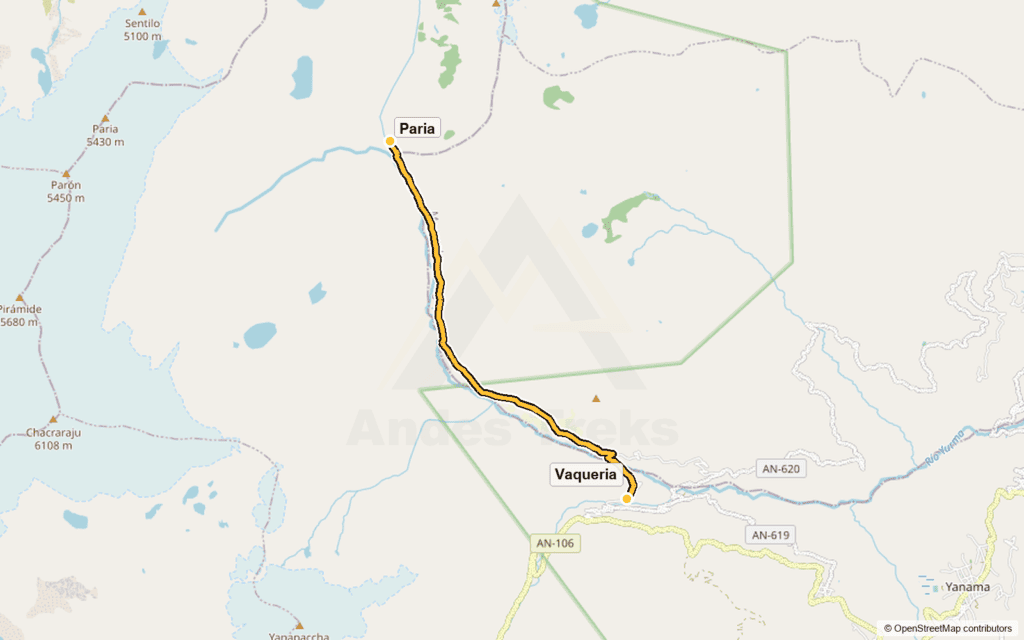
Today
Our Santa Cruz Trek 4 days begins with an early departure from Huaraz. We travel north through the Callejón de Huaylas before turning toward Yungay and entering Huascarán National Park.
The road continues through the Llanganuco Valley, passing the turquoise waters of Chinancocha and Orconcocha. We then climb toward Portachuelo de Llanganuco, where clear conditions reveal Huascarán, Huandoy, Chopicalqui, Chacraraju, and the eastern valleys of the Cordillera Blanca.
After crossing the road pass, we descend to Vaqueria and begin hiking at approximately 3,467 meters. The trail passes small Andean settlements and cultivated fields before entering the quieter grasslands of the Huaripampa Valley.
A steady ascent brings us to Paria camp at 3,808 meters. Our Andes Treks team prepares camp while you rest, hydrate, and get ready for the demanding crossing of Punta Union.
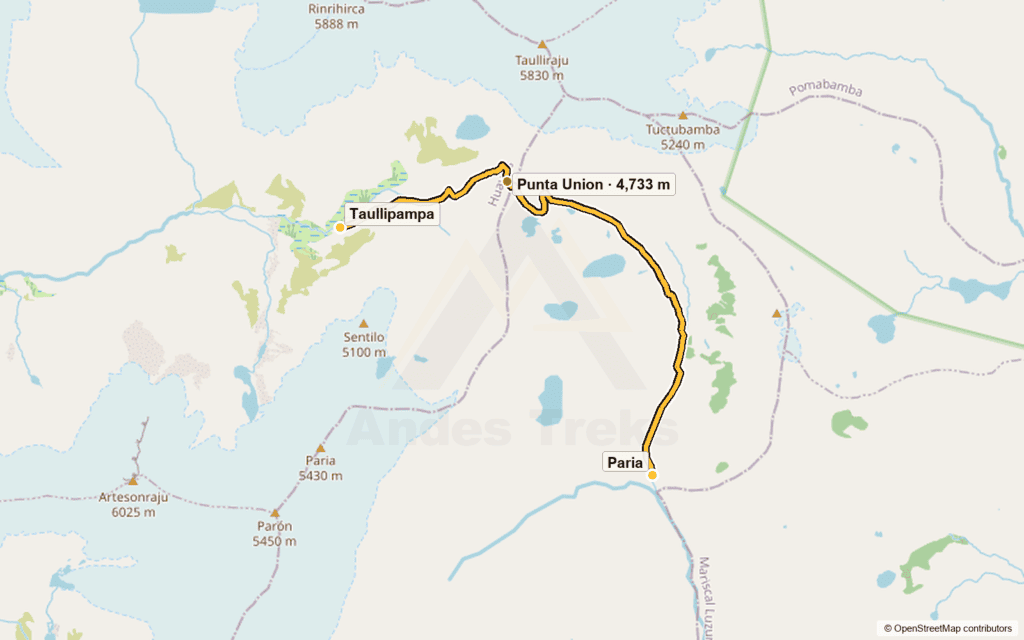
Today
We leave Paria early and continue deeper into the Cordillera Blanca. The trail climbs through a broad glacial valley, passing wetlands and small alpine lakes as the surrounding mountain walls become increasingly steep.
The ascent intensifies above Morococha as we approach Punta Union. Our guide maintains a controlled rhythm and schedules regular pauses, allowing the group to manage the altitude safely during the largest climb of the itinerary.
At 4,733 meters, Punta Union is the highest point of the Santa Cruz Trek 4 days. The narrow pass provides expansive views toward Taulliraju, Rinrijirca, Quitaraju, Artesonraju, and the lakes of the Santa Cruz Valley.
We descend carefully from the pass to Taullipampa. Camp is established at 4,182 meters beneath Taulliraju, with views toward the surrounding glaciers and the route leading to Alpamayo.
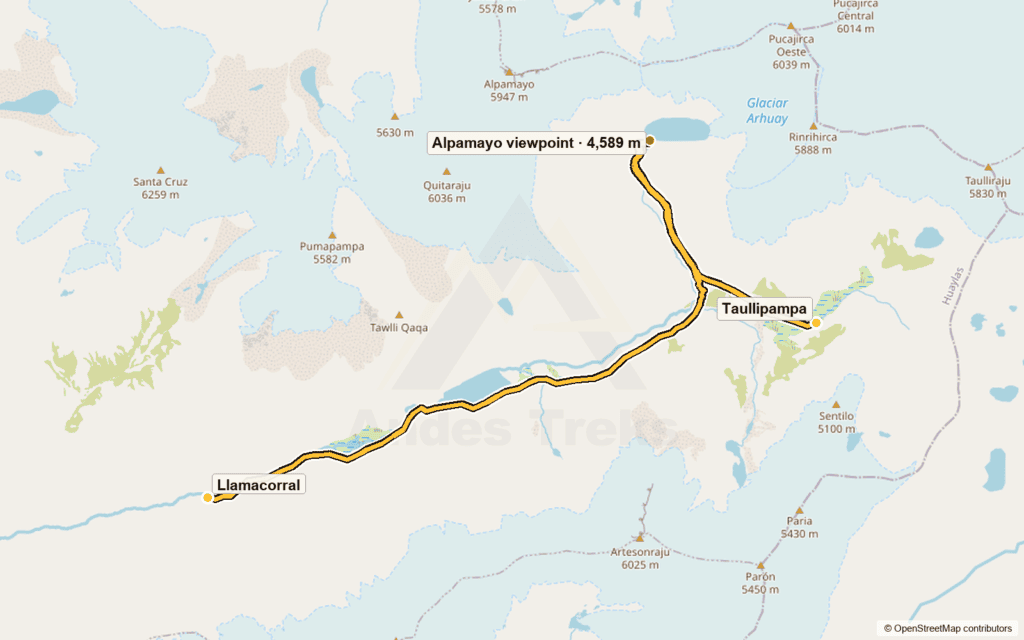
Today
We begin with an excursion toward the Alpamayo side valley. The path rises above Taullipampa and leads toward the base-camp area, where the sharp ice-covered pyramid of Alpamayo becomes the main feature of the landscape.
The highest section of the recorded route reaches approximately 4,589 meters. From this area, we can appreciate Alpamayo, Quitaraju, Artesonraju, and the glacial basin surrounding Laguna Arhuaycocha.
After exploring the viewpoint, we return to the main Santa Cruz trail and begin a long descent through the valley. Along the way, we pass the turquoise waters of Jatuncocha and Ichiccocha, surrounded by waterfalls, high meadows, and granite mountain walls.
We arrive at Llamacorral at 3,786 meters for our final night in the mountains. Although most of the second half is downhill, the distance makes this one of the longest days of the trek.
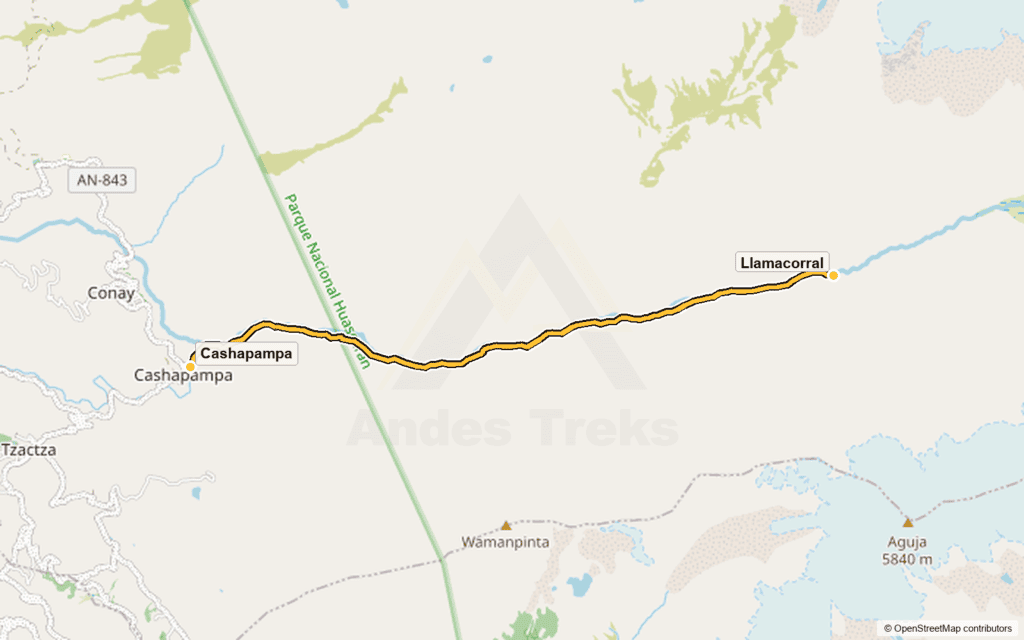
Today
Our final morning begins at Llamacorral. We follow the Santa Cruz River downstream through open grasslands before the valley gradually narrows into a deep canyon.
The path passes waterfalls, native vegetation, and polished rock walls shaped by ancient glaciers. As we lose altitude, the climate becomes warmer and the high alpine landscape gives way to shrubs, trees, and cultivated land.
Most of the route is downhill, but the sustained descent requires a steady pace and careful footing. Trekking poles can be useful for reducing pressure on the knees during the steeper sections.
We finish the hike at Cashapampa at 2,950 meters. Here, we meet the vehicle for the return journey through the Callejón de Huaylas to Huaraz. The road distance is separate from the hiking distance shown above.
Distances, hiking times, routes and arrival times are estimates. Your guide may adjust the itinerary due to weather, trail conditions, safety considerations or the needs of the group.
Real experiences
Santa Cruz Trek 4 days reviews
A serious trek deserves serious preparation